
Yesterday was a busy day and I forgot to do a blog post. . . oops!! Our internet is being really slow also so I don't think I will be able to upload pictures right now, maybe later.
The soccer game on Sunday went well. . . our team made it to the playoffs!
The DSAT Buddy Walk went very good in Tulsa on Sunday also. Lots of people came and all around it went very well. Hopefully I can get some pictures from there put up later.
That's it for now! Have a great day!
Suriyah
Tuesday, October 18, 2011
31/21 - Oops!
Sunday, October 16, 2011
31/21 - Donkeys & Rams
When this post goes up, I will (most likely) be gone to our Sunday soccer game and then the Down Syndrome Association of Tulsa's Buddy Walk.
These 2 donkeys are new here. If anyone is looking for a cute donkey, let us know ;)!

We also got 2 new rams for our sheep breeding programs. The black and white one is a 3 year old Katahdin/Dorper cross ram. He is very nice. The red one behind him is a red Katahdin, and is under a year old (very big).

Flying rams!!

Hope you have an awesome day!
Suriyah
Saturday, October 15, 2011
31/21 - Meet Dynamite
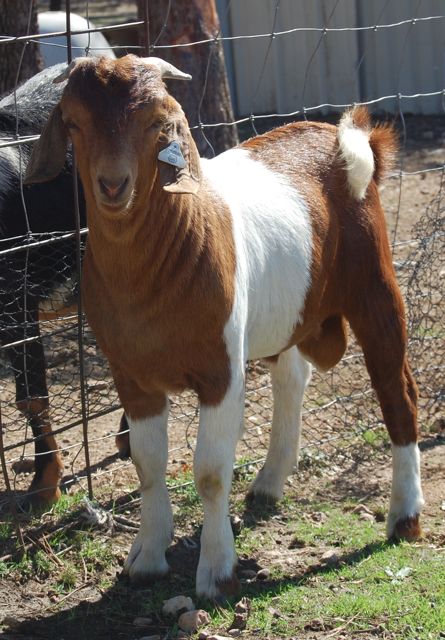
This is our new Boer buckling.
He is young, very big and very colorful.
He has already bred his first doe here.
His name is Dynamite.
I can't wait to see kids out of him!



Suriyah
Friday, October 14, 2011
31/21 - Random pictures, broken leg update
Yesterday I took off the brace from Cleopatra's broken leg. It looks good. She is using her leg almost like normal, although she still favors it a little bit. It looks like it healed a tad bit crooked, but I think it'll be just fine.
Here's a few random pictures from yesterday. Enjoy!

"Blondie"

"Chicci"

this doe looks like she is going to kid soon!


silly goat!

Suriyah
Thursday, October 13, 2011
31/21 - Farm C-Section
WARNING: Graphic photos below.


So she was put to sleep, we immediately had a sharp knife and made an incision.

It took just over a minute before we found the uterus with the kid in it. Since he was already in the birth canal (somewhat), his head was out of his sac, so it looked like he was in a little bag.

We got him cut out of it and started rubbing him. He started breathing and crying very quickly.

A few minutes later, I had him in and he was already wanting to nurse. I rubbed and rubbed him, dried him off, and he nursed a bunch. Thankfully, I had just milked out colostrum from the other Boer doe that kidded since she had too much. Perfect. I felt sorry for the poor kid because his legs and head must have been sore from us pulling on him for so long and so hard!

He is a huge kid, at least probably 12 pounds. (and this doe was tiny, probably one of the most narrow Boer does ever). He is also very healthy, and I think he is polled (naturally hornless).

So, it was a sad evening and a happy evening. Life on the ranch can be hard at times, and hard decisions have to be made. I was very excited that we were at least able to save the kid.
The Boer doe that had triplets the other day is doing ok. The babies are doing great. I do not know this doe's history, but she seems to be very old. She's a sweet old gal, but she came down with hypocalcemia. She has only been with us a for about a month or so, so I have no idea how she was fed before - obviously not very well. I left the 2 does on her, and pulled the buckling to be a bottle kid. This way he'll be a friend to the new orphan and the doe won't have to produce as much milk, just feeding 2 small girls. I am treating her every 2 hours, I really do hope she pulls through.

Suriyah
Wednesday, October 12, 2011
31/21 - Bounce-U & Buddy Walk!
Yesterday was the Bounce-U prep event for the Down Syndrome Association of Tulsa Buddy Walk on Sunday. It went very well and we were all very tired after handing out bags and bouncing for hours.
The Buddy Walk is this Sunday, starting at 1:30 at the Union Park. Anyone and everyone is welcome! If you can, come spend the afternoon with us! You can find out more info here.


Suriyah
Tuesday, October 11, 2011
31/21 - Triplet Kids Born!
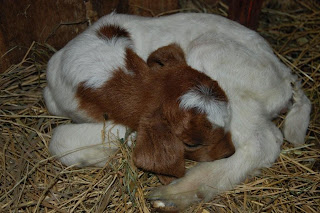
Yesterday morning a Boer doe that we got a few months ago, gave birth to triplets! 2 girls and a boy. The girls are way smaller than the buck, they are just adorable! Here's a few pictures.


Gotta go!
Suriyah
Monday, October 10, 2011
31/21 - Feeding article
Here's an article on feeding (goats) that I wrote. Just the way we do things here and thought I'd share!
Feeding
Whether
you are a novice goat owner to an experienced rancher, it seems there
are always the constant questions about what and how much to feed.
After many, many changes over the years with our herd, figuring out
what works best and what doesn't, I think we have finally narrowed
things down for our herd. But as always, one thing is not going to
work for everyone. Depending on what part of the country you are in,
whether you are dry-lot feeding or pasture raising your goats,
management and feeding issues are going to vary a lot.
Goats
have many nutritional requirements and dairy goats are one of the harder to keep
livestock, at times. Milking does and growing kids need calcium. The
most common source of calcium for goats is good Alfalfa hay or
pellets.
Remember
when you are feeding goats, you are feeding the rumen. The goats
rumen is a very complex system, and requires lots of nutrients from
hay, pasture and browse. Goats are browsers, which means they eat
lots of forage and cannot do well just off of a pelleted or grain
based diet. Turned out in a lot with forest and grass pasture,
typically the goats will go to the forest first and eat the leaves,
bark and various things first before going to eat the grass. Whereas
sheep on the otherhand, will not typically eat the leaves and bark
like goats do, they'll go straight for the grass (which has earned
them many nicknames, but this isn't about sheep).
What
we have been feeding our herd for years now, is this.
Milkers
get Alfalfa or Alfalfa/Orchard grass hay twice a day. After the
morning feeding, during the pasture months, they will go out and
browse all day long. During the winter months, they get fed more hay.
On the milk stand, each milker gets between 1 to 1.5 pounds of grain
each milkling. So a doe, depending on production and size,will get a
total of 2 to 3 pounds of grain a day. We feed a 14% protein grain,
with 3-4% fat.
Kids
get fed grain once a day and then are given lots of alfalfa or
alfalfa/orchard grass hay. It is best for kids to have free-feed hay.
I am not a big grain fan, so if the kids are growing well and don't
seem to be lacking, they will not get any grain at all, only hay and
milk. If you are bottle raising your kids, the longer you can keep
them on the milk bottle, the better. They get a much better start in
life this way. Our kids are typically bottle fed until 5 months of
age.
Dry
does and bucks get pasture all day (when it's there), and alfalfa or
alfalfa/orchard grass at least once a day. If the pasture is not
good, they get fed hay once in the morning and once in the evening.
If
there is any animal that is thin for some reason, first start out
with trying to figure out why they are thin. Worms, mineral
deficiency, etc. Once you have that taken care of, you can give them
Black Oil Sunflower Seeds, Rice Bran, Soybean Meal or Calf Manna as
these are all very high in fat and protein.


Suriyah
Sunday, October 9, 2011
31/21 - Sunday
It's Sunday. As usual we went to our soccer game this morning. It was a good day.

A few days ago we sold all the remaining little bucklings that we had. . . that meant Mr. Tic-Tac had no more little friends. So, he had to graduate to the big boy pen. He is doing just fine. There is another buckling in there from this year also, he is a few months older and MUCH bigger, but Tic-Tac seems to be holding his own just fine. Plus, our bucks aren't very rough with each other either.

I am exhausted, and that is not good because we have a very busy week ahead of us. Hopefully I can squeeze my blog posts in!
Hope you had a great day too!!
Suriyah

Saturday, October 8, 2011
31/21 - Enterotoxemia
Since it's a super busy day, I figured I would just re-post my article on Enterotoxemia.
Enterotoxemia
Years
ago we'd had a some new bales of alfalfa hay, it was really green and
leafy, and the goats loved it (of course). Before going to bed that
night, I heard a kid crying. We had some kids being dam-raised, and
had a beautiful F3 MiniNubian doeling named Midget. We went out and
checked - everyone looked fine. So as usual, we went to bed. A few
hours later my Mom awoke to a kid screaming/crying in pain. She went
out there, it was Midget. She tried to save her (gave her many
things) but within minutes she passed away. We read and she had the
exact symptoms of Enterotoxemia, and the single thing that will save
a goat's life in the case of Entero., we did not have - C&D
ANTITOXIN
(not
the toxoid). A hard lesson learned.
It's been many years since
that happened. I've read a TON about Enterotoxemia and never lost a
goat to it again, thankfully. A few times the goats have got into
grain, or a goat has bloated, etc., and I always give
them a shot of CD Antitoxin. The worst thing C&D Antitoxin
can do is, if you vaccinate, is it will negate the CD&T vaccine.
The best C&D Antitoxin can do, is save a goats life.
A few
months after we lost Midget to Enterotoxemia, a lady called us up and
her kid was sick - sounded like she had Enterotoxemia and she was so
far into it she was laying on the ground with her eyes rolling back
in her head. The owner did not have the antitoxin, so she rushed to
our house, got a few syringes full of it, went home and gave it to
her doe kid - she was back to normal within hours.
Ever since we
lost Midget to Enterotoxemia, we've never been without the C&D
Antitoxin in the fridge. I always stress to new goat owners that this
is the one thing your medicine cabinet should never be without.
So,
how would you know if your goat has enterotoxemia?
Well,
it definitely takes a lot of watching your goats, knowing their
normal habbits, sounds and routines. The symptoms of Enterotoxemia
can be very widely ranged. It can be as simple as a goat crying - but
this isn't just any cry - it's a cry that the goat either is getting
seriously injured or has enterotoxemia. Once you've heard it, you'll
remember it. It's the cry of a goat in pain.
Enterotoxemia can also
come on after a goat has bloat, has diarrhea/an upset stomach, is
stressed, a slight (or large) change of feed, a bottle kid drinking a
large/abnormal amount of milk, or possibly even weather change -
these are all prime conditions for enterotoxemia to kick in.
What
about if you vaccinate with the CDT Vaccine? It's suppose to
prevent it, right?
We
choose not to vaccinate our goats. There is a bunch of info why
not to vaccinate here. My goats are healthy, we do not believe
they need vaccines - after awhile they just suppress the immune
system anyway. I know everyone won't agree on this subject, but
that's okay.
If you DO vaccinate, your goat can still get
Enterotoxemia. The vaccine will lessen the chance of an adult goat
getting it, but it's still possible. And the vaccine does not protect
young kids from getting enterotoxemia.
Like I said before, if
you even think your goat may
be
getting Entero, don't hesitate giving them some C&D Antitoxin.
The worst it can do is negate the vaccine, the best it can do is save
a life.
A goat with Enterotoxemia really needs to be treated
like this - C&D Antitoxin (reduces the gut flora that has
overgrown), Pepto bismal (to line the gut and protect it), Banamine
(calms the gut and eases pain), baking soda won't hurt and if the
goat is really bad, starting them on Penicillin is also good to take
care of any infection that might set in. The goat should be
re-treated every 3-6 hours with the C&D Antitoxin and Pepto until
the syptomes subside. An adult goat should get anywhere from 10-15 cc
sub-Q of C&D Antitoxin, and a kid should get around 5 cc.
Another
important thing to note is when a bottle fed kid has enterotoxemia,
do not feed them milk. Instead of milk, give them electrolytes
(prefferably clear). You do not want to overload the gut with more
milk when it cannot handle the stuff already in there.
In
conclusion, watch your goats.
Subscribe to:
Posts (Atom)


